5 MIN READ
The recent wins of 2020 in 2021, both of Eurovision Song Contest and UEFA Euro, taken by Italy, were to reclaim the year lost in hardship and despair. The country does not lack big names, wins, and achievements – from Marco Polo to Galileo Galilei, from Leonardo da Vinci and Tintoretto to Fellini and Alessandro Michele, from Monteverdi to Verdi, from Dante to Umberto Eco to Good Night Stories for Rebel Girls. Italy has given the world opera, Alta Moda, and its widely adored savory foods, and once again has just shown it its three /k/s – character, quality, and class.
Personally, Italy has long been a priority destination to visit and explore, largely due to its magnificent cities and landscapes, and, of course, language – sight for the eyes and music to the ears. Italian is an Indo-European East Romance language (Italo-Celtic – Italic – Latino-Faliscan – Latin – East Romance) and shares the family together with Dalmatian and Romanian languages. Among other Romance languages, we find French, Spanish, Portuguese – all West Romance. Their cousin Italian, remaining closest to the original Latin, is an official language in Italy, San Marino, one of the four national languages of Switzerland, and spoken by almost 70 million users worldwide, including large Italian diasporas in North and South America.
It is assumed that half of Italy’s population does not use standard Italian as we know it as their first language, and there are more than a dozen distinct and often unintelligible to each other dialects. Previously known for its numerous separate states and own vernaculars, the Italian region was pieced together as one kingdom in 1861. The literary standard of Italian was created largely through Dante’s Divine Comedy and the writings of Petrarch and Boccaccio in the 14th century. These men’s home was Tuscany, and they mainly wrote in the Florentine dialect which laid the basis for the modern literary language. The dialect of Rome has raced to become standard since 1870 when Rome too was finally a part of Italy but had no success in surpassing the Florentinian, which was brought into use by state television since its commence in the 1950s and thus retained the status of a standard language.
Besides, the year 2021 Italy has dedicated to the father of the Italian language Dante Alighieri and marks 700 years since his death in Ravenna in 1321. A virtual exhibition at the Uffizi Gallery* in Florence, Dante’s birthplace, is one of many events dedicated to the poet.
For those who already speak English, Italian is deemed one of the easiest languages to learn. First, both languages have much of common Latin-rooted vocabulary, such as costano (cost), falso (false), introduzione (introduction), esercizio (exercise), and many more. Knowing some French helps a lot, too. The sentence structure and pronunciation are rather rhythmic with the use of many vowels making the language easy to grasp and attempt to speak.
Even if we don’t speak or learn Italian, there are enough Italian borrowings** we use daily, the ones like pizza and risotto. Many Italian words are pronounced as written. Some words can be a challenge though. Bruschetta or words that contain the sound g tend to adopt English pronunciation. In Italian, the letters ch and cch are pronounced k, and the letter g is pronounced as a hard g before a, o, and u, e.g., gamba-leg, but as j before e and i as in gelato-ice-cream and giorno-day. It is however silent in the consonant digraph gn. Can you guess how the word gnocchi is to be pronounced? Yes, [‘njʌki]. The incorrect pronunciation of bruschetta is rightly noted in the Norwegian Joachim Trier’s film Oslo, August 31st (2011), by the main character, the intellectual drug abuser Anders, commenting on the error made in the conversation when ordering Italian food. An example of a life situation when knowing some Italian comes in handy.
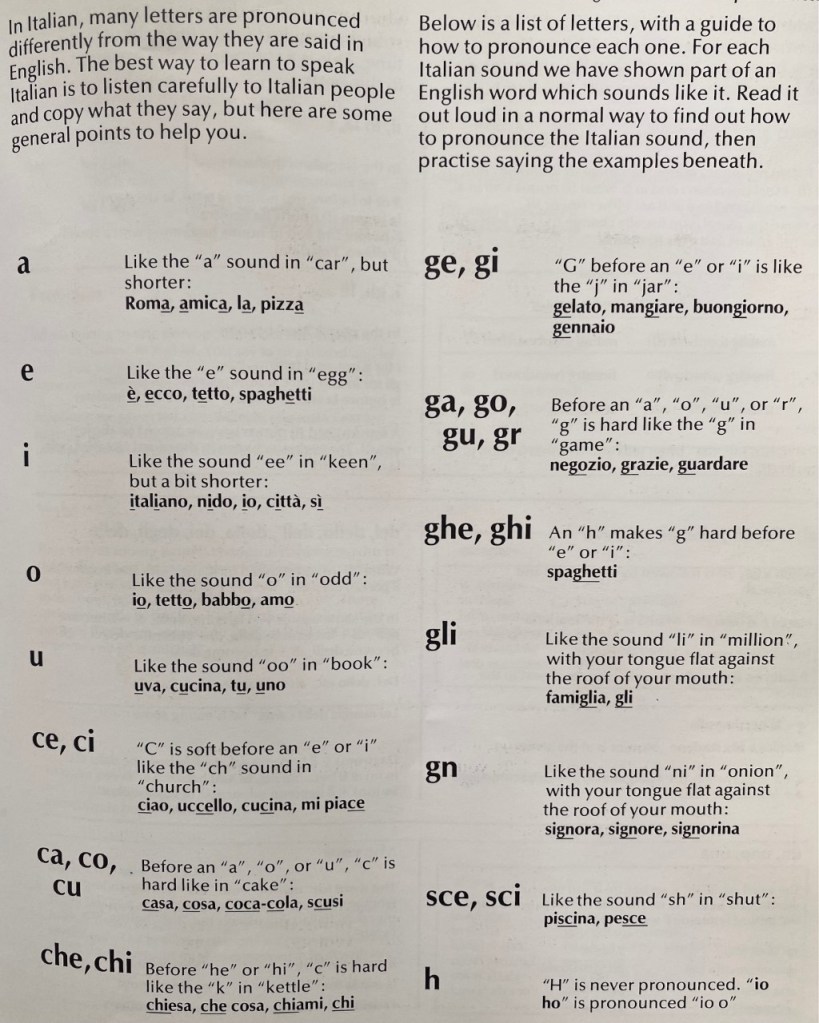
English words of Italian origin are bank, manage, umbrella, balcony, malaria, volcano, and inferno. Let’s not forget the music words such as piano, viola, opera, aria. These are easy to pronounce regardless of the language it is used in, aren’t they? Watch out for false cognates like stanza which in Italian means not only a verse as in English, but first and foremost a room, apartment, or guidare – to drive and guardare – to look, watch.
If this was not convincing enough to pick up a little Italian, then hopefully at least was somewhat useful and maybe even inspirational to dream of the next holiday destination. Buona fortuna!
**
* The virtual exhibition The Uffizi Gallery https://www.uffizi.it/en/online-exhibitions-series/to-rebehold-the-stars
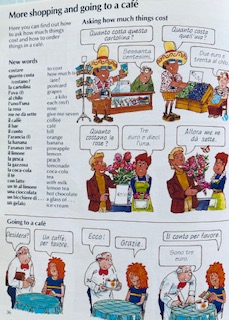
**Borrowings – acquired new words from other, often unrelated, languages, e.g. risotto and pizza from Italian, vodka from Russian, goulash from Hungarian, coffee and yoghurt from Turkish, alcohol and sherbet from Arabic, ketchup from Chinese, tomato from Nahuatl (spoken in Central America). (Linguistics. An Introduction by Andrew Radford et al. (2009) p. 224.)
Sources: Ethnologue; Italian For Beginners by Angela Wilkes (2001); The Languages of the World by Kenneth Katzner (1975);
 Ventral Striatum