14 MIN READ
As we are in Pride Month, it is time we talk about diversity, equity, and inclusion in language. Efforts to embrace diversity through language seem to have never been greater.
Awareness of language use and the creation of new words and concepts recognize, welcome, and honor the diversity allowing individuals to proudly express and present themselves to the world in ways not or less possible before, at least in and to the English-speaking world. Expression of gender identity and use of gender-neutral language have especially been salient.
According to the linguist Steven Pinker’s definition, gender is how languages categorize their pronouns* and nouns. In many languages, the genders of pronouns correspond to the sexes (he and she), and the genders of nouns are determined by their sounds (e.g., words ending in –o or –as are one gender, words ending in –a are the other) or simply divided into two or three lists defined by articles like den versus det, or het versus de, or der versus die versus das. In some languages, gender is determined by various distinctions, for instance, human versus nonhuman, animate versus inanimate, long versus round versus flat, and others (p. 507, see sources below).
Pronouns are words that stand for and replace a noun expression (e.g., Ann, the teacher, a book of yours) where personal pronouns are the most common and can be either singular or plural and differentiated in terms of person: first I/me and we/us, second you, and third he/him, she/her, it, they/them. In some languages, pronouns can be totally gender-blind, having one word only to express it. In Finnish, the common word for he and she is hän, in Estonian, there is one gender pronoun ta, in Hungarian – ő, in Saami – son. All belong to the Finno-Ugric** language family. In Basque***, another non-Indo-European language of Europe, distinguishing between genders is too absent. Chinese, for instance, has no difference in gender pronouns in terms of pronunciation – tā stands for he and she. They are, however, represented by two different characters in writing (他-he, 她-she).
Sweden is purported to be inspired by neighboring Finland, and next to the existing conventional han (he) and hon (she) it launched its neutral or common gender form hen in 1966. In recent years, the same pronoun form can be noticed reading Norwegian press. The identical common gender pronoun hen has been officially approved by Det Norske Akademi dictionary along with its object form hen and its genitive case hens. Though an official entry of the equivalent pronoun not yet seen in any Danish language dictionary (maybe my sources have been too scarce), it seems to be catching up with the trend, and a very recent book Han hun hen by a Danish author makes it conspicuous and throws us here in Denmark into an exhilarating stereotypes challenging debate.
Speaking of pronouns and Sweden, it is worth mentioning its du-reform when Swedes initiated the use of du (you) pronoun, ditching the polite form Ni in the late 1960s. Followed swiftly by Norwegians and Danes replacing their De with du, Scandinavians since have addressed each other most familiarly regardless of the title and position interlocutor holds or what age they are. It may sound quite unusual and somewhat uncomfortable for Germans who use Sie, Russians who have Вы, also Italians who say Lei to express politeness. Although previously rather prudent about their polite forms, Swedish people embraced and adopted the reform nearly overnight, addressing each other, including the prime minister, in du-form. There have been even, though still fruitless, suggestions from the radical Swedes’ side to completely eliminate second-person pronouns to make the language even more inclusive and less discriminatory.
In other languages, too, a shift has been noticed in addressing people, whether by pronoun or noun. In English, a plural pronoun they instead of he/she is becoming more a common option as generic singular, and in Italian, Signorina and Signora have converged into a singular form of Signora, and no one risks making the distinction when addressing a donna nowadays.
While, like in Scandinavian languages, one may only need to change a pronoun, and the rest falls into places in terms of verbs, adjectives, and other speech and sentence parts****, other languages encounter complexities and have all grammatical forms involved and affected. In English, there is no difference between he is nice, she is nice, or ze is nice. The same would be harder to implement in French, Italian, or Russian, where the speech parts need to be congruent and correlate with each other grammatically to coexist and make sense (Il est gentil, elle est gentille).
When translating technical texts, I intentionally adjust the Lithuanian, a two-gender language, translations according to both genders. As a result, Lithuanian sentences become longer and lacking natural flow. Typically, the machine translation software is programmed to pick masculine, so-called general, grammatical forms. This pre-defined selective automacy I simply tend to defy and not conform to. It requires more conscious and painstaking work from my side, but I feel it necessary to make the language as fair and inclusive as possible. Someone Lithuanian who reads the translation may otherwise experience it as written exclusively for men. (A sneaking feeling tells me, however, that the majority of the vernacular speakers would not be too bothered because the masculine and heteronormative language is ingrained in our minds and may even be experienced as the most natural).
Understandably, grammar***** is harder to change and adapt than a couple of distinct words. But not entirely impossible, having in mind that, for instance, English once (roughly before the 14th c.) had both noun genders (3) and cases (4) which is hard to imagine it could have existed knowing today’s Modern Standard English. Nouns are one of the major parts of speech that refer to an object or person. In terms of gender, let’s take profession-related nouns. Many languages seem to have both masculine and feminine noun forms to name a doctor or a lawyer, and as soon as one attempts to make the language general or neutral the masculine forms are usually used. It offends my ears every time I hear a Lithuanian call the government valdžios vyrai (men of power) despite the fact that the current Prime Minister, the Speaker of the Seimas (the Parliament), and many other high ranked posts are or lately have been occupied by female politicians. The ten years of two consecutive terms of President woman office has not been long enough to change Lithuanian mindset a tiny bit and with it the language to express the perception of the present world. In Russian, masculine grammatical forms of professions such as director – директор, doctor – врач, professor – профессор are applied to name both men and women (врач Александр – doctor Aleksandr, врач Мария – doctor Maria). The feminine grammatical forms exist and sound, in fact, more like a derogative slang than an honored title (врачиха – woman doctor, директриша – woman director).
The French philosopher Monique Wittig has argued that language is “an instrument or tool that is in no way misogynist in its structures, but only in its application.” To understand words’ application, we turn to etymology******- the study of the history of words. The Catholic Church, for instance, once supposedly questioned whether a woman was human and possessed a soul. The doubts purportedly lay in the meaning of particular words. In Classical Latin, the word homo meant a human being with no gender distinguishing, while the word vir denoted man. In French, there was only one word homme, which represented both human being and man. In the 5-6th c., the word vir became less common in Latin replaced by homo and understood in a new way to denote man. Sometimes women too were called by the same word but commonly the word mulier meant woman. The word human being, i.e., žmogus in Lithuanian, is a masculine grammatical form noun, and therefrom perennial misogynistic jests and even songs about women as non-human beings that persist to this day.
In May, the webinar organized by Planet Word, the language arts museum in Washington, D.C., discussed the language in terms of gender or, as called by one of its speakers, the “complicated mess of gender language.” The webinar covered fascinating insights about the human identity and its expression through language, e.g., gender users vs. pronoun users, some personal experiences from the LGBT+ community, and the book The Queens’ English: The LGBTQIA+ Dictionary of Lingo and Colloquial Expressions. The main goal of the webinar was to stress the importance and the need to create a language for visibility and representation, and as said by another speaker: “language is not to put us in a box, but understand and help eradicate racism, homophobia.”
In earlier mentioned Saami language, there has been a lack of sexual words to name certain private body parts, sexual actions, and diseases until a recent initiative taken by the youth council that translated and coined the new much-needed words. The new COVID language has numerous examples of how new terms enter a language through direct translation. Concepts unheard of before the pandemic have become routine language directly translated into others to communicate effectively and avoid misinterpretation across borders and cultures: the acronym itself COVID-19, phrases like social distancing, risk groups, self-isolation, among many others.
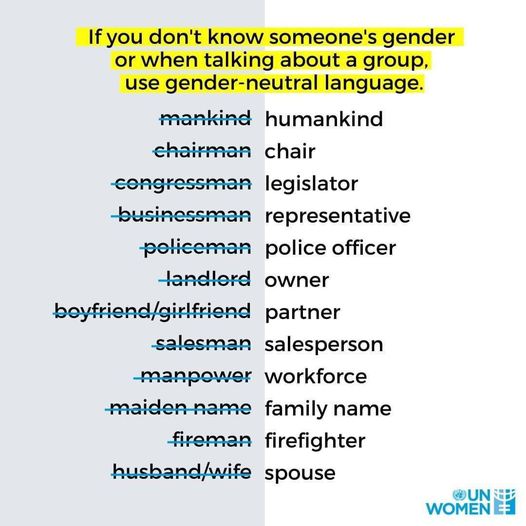
New words and concepts do not always need to be invented. The ones such as businessman, wife, and husband are consciously being replaced by representative and spouse. The latter are no new inventions, they have been around, it is just that they haven’t been used as much or previously used in other contexts to serve other needs.
The Spanish philosopher José Ortega y Gasset considered the exact correspondence between two languages utopian since two words in different languages cannot possibly refer to the same object that exists in two different realities. According to him, people speak the same concepts, not words. These then need to be translated and into all languages to serve the global community. The Bugis, for instance, the ethnic group of the Indonesian island of Sulawesi, distinguish between five separate gender concepts and name them accordingly: female –makkunrai, male – oroani, individuals born with female bodies but assume traditionally male gender roles – calalai, those with male bodies but assume female gender roles – calabai, and the ones considered intersex who represent the total gender spectrum – bissu. Another example comes from Mexico’s southern state Oaxaca’s indigenous Zapotec language with three genders: female, male, and muxes but only one gender form to name all people. The equivalent concepts, let alone words, would be quite impossible to find when translating into an Indo-European language like Lithuanian, for example.
As languages are already diverse with countless amounts of words and expressions coined, it may backfire and sometimes lead to more confusion than clarity. The more words we invent with the purpose to specify and narrow down the meanings, the more we may bewilder and pave ways to misinterpretation or multi-interpretation, individual understanding caused and based on the personal experience, beliefs, and ideas about the world, even culture. Sometimes lack of knowledge of the particular word is due to unawareness or absence of that particular word through translation or mistranslation. It becomes obvious how important translation work and communication between cultures is. The latest hottest debate in Lithuanian society has been the Istanbul Convention which, due to lack of unanimous agreement on the translation of the text and the dispute over particular Lithuanian words or concepts in the convention, have not only delayed to ratify and formalize it but caused public contempt, storms on social media platforms and even street protests opposing the convention which is meant primarily to urgently help put a stop to gender-based violence. All due to certain socially delicate concepts that exist in English but are absent or misinterpreted in another language like Lithuanian.
We often claim that language is in constant change and a reflection of the world we live in. Certain and significant to the present actualities may need a better reflection and a prompter shift in language. If not yet impressed by the flexibility of Swedish, here comes another example of how Swedes are linguistically equipped to tackle discrimination in work, home, or social environment. Härskarteknik, which can be translated as master suppression techniques, has given necessary concepts and common language to address gender-related challenges to name and identify a common experience shared by individuals versus individual personal feelings. The theory was created by a Norwegian, the exact words exist in Danish, but only Swedes seem to have put it to use and practice.
It seems there is an urgent need for both new words and concepts to enrich and diversify languages and do it both ways, to specify but also neutralize so that languages could serve everybody’s needs. For some, possibly due to personal experience, it is a priority to avoid being misidentified, mispronouned, and misgendered, mainly when others refer to them. Instagram, LinkedIn, and other online platforms have introduced gender pronoun visibility for that purpose and is, by the way, so far visible only in English. On the other hand, my dream is to be able to dedicate or translate a text to the audience regardless of who the reader is. As a speaker or a writer who interchangeably uses several different languages, I require the tools, i.e., words, to address a diverse crowd by uniting and without excluding anyone. To address and reach diversity, I am in need of equal neutral language.
A good start has been made, even though only in English. The encouraging examples of Sweden and the COVID-19 language prove it possible. The gender-related language needs to transcend and penetrate other languages sooner rather than later. Here is what UN Women suggest on how to go forward if you speak English. ALL other languages will hopefully follow.
******
*Pronouns -a word that stands for a whole noun phrase: I, me, my, you, your, he, him, his, she, her, it, its, we, us, our, they, them, their, who, whom, whose.
**Finno-Ugric (sometimes known as the Uralic) is a non-Indo-European language family with such members as, for example, Hungarian (stems from Finno-Ugric >Ugric > Hungarian); Finno-Ugric > Finno-Permic > Permic > Komi; Finno-Ugric > Finno-Permic > Finno-Volgaic > Finno-Saamic > Saami (Lapp); Finno-Ugric > Finno-Permic > Finno-Volgaic > Finno-Saamic > Finnic (Balto-Finnic) – Finnish; also Estonian, Livonian, Karelian, Ingrian; some other small languages mainly spoken in northwest Russia.
***Basque- an isolate language, repordedly the oldest language of Europe with no connection proven with any other language; spoken by around halv a million speakers mainly in northwest Spain.
****Parts of sentence – syntax – the component of grammar that arrange words into phrases/sentences; study of sentence structure out of words and their correlations; subject, verb, object, etc. Parts of speech – the syntactic category of a word: noun, verb, adjective, preposition/postposition, adverb, conjunction.
*****Grammar – a set of rules that determines the form and meaning of words and sentences in a particular language as it is spoken in some community. (The Language Instinct, Steven Pinker, p. 508).
******Etymology – a study of the history and origins of words and the way in which their meanings have changed throughout time.
Sources: Bernardinai.lt; “Lingo. A language spotter’s guide to Europe” by Gaston Dorren (2015); “Language Instinct” Steven Pinker (1994); “Gender Trouble” Judith Butler (1990); “Historical Linguistics” Lyle Campbell (2013), BBC.com, NRK.no
 Ventral Striatum