5 MIN READ
Once there was a time of a flow of events, gradual, some slower, others faster, developments and progress towards some infinite future and some kind of distant goal. Then 2020 happened, and the chain of events has cracked.
Life seemed to have stopped, and things changed overnight, making some become obsolete, and others exceed. A catchy-sounding number of twenty twenty has turned into a memorable and symbolic one that draws a line in the world’s history between before and after. After – when technology developments have stepped up, nature took a fresh breath, scientific achievements became improved and instantly possible. And when the uncertainty grew: will we ever go back to jam-packed airports, crammed cinemas, busy office landscapes, how will a school look like, will we return to classrooms and practice languages in groups and pairs off the screens and in-person again?
The use of technology has already been omnipresent but this year reached its peak. Creative initiatives popped up all over the internet, and virtual learning platforms were a savior in need for the teachers to continue their work and created a possibility to reach remote students who otherwise would not receive tutoring at all. The online language learning approach has also become a new activity of my own during the summer, which has expanded and spilled over to the fall, winter and probably will continue next year. Online Danish conversation sessions with new friends around Denmark who need to communicate and use the language have been truly enjoyable.
You have most likely heard that the phrase of the year 2020 unsurprisingly is ‘you are on mute‘. Apart from zoom family gatherings and virtual parties with friends, online seminars have reached and united people, professionals, and curious ones, to learn, discuss and share information on multiple topics like never before. I personally have had a chance to sign up for conferences and fascinating talks with remarkable personalities, also the language and education-related activities not only locally but all over the world as well: e.g., European Language Day celebration, project “ENRICH ME: Linguistic Diversity in English Language Teaching” broadcasted by Oslo Metropolitan University (Norway) among others. The events would otherwise have had a physical format and entail traveling and a strict participant selection. By the way, podcasts have also notably increased in popularity and numbers during 2020.
The world is changing and nothing is eternal, including languages. This year, in August, Aljazeera reported that the Yaaku language became classified as extinct since fewer than 10 people in the world can speak it today. As the Yaaku tribe’s language in Kenya dies out, so will these indigenous peoples’ traditions and cultural identity. The Yaaku language belongs or rather belonged to the large Afroasiatic language family and its Cushitic branch. It is claimed that one-third of the world’s languages come from Africa. And according to the UN cultural organization, UNESCO, as many as 200 of the languages spoken in African countries may disappear within the next century.
Some things end, others begin. In October, despite the lockdown hurdles and restraints, a magical place, Planet Word, in Washington D.C. opened its doors. This wonder is an extraordinary new museum entirely dedicated to words and languages.
In November, a language-related dispute reoccured between Bulgaria and North Macedonia while the latter is striving to become an EU member state. It is not the first time that language plays a political role and that an EU member poses certain requirements in policies and changes for a non-EU neighbor. In this particular case, Bulgaria wishes North Macedonia to formally recognize that its language has Bulgarian roots, and the Slav Macedonian majority in the country speaks Bulgarian, or its dialect, not Macedonian. The two countries share an intricate and overlapping history, common regions, and close related languages. Both are children of the Indo-European language family and belong to the South Slavic group alongside Serbo-Croatian, Slovene, and Old Church Slavonic. Both using the Cyrillic script, the languages seem indeed very similar to an outsider. Despite numerous similarities, like script and lexicon, there are however some differences in grammar. Bulgarian uses definite and indefinite article* both suffixed to the noun (e.g., indefinite: ‘език’ – ‘language’; definite: ‘езикът ‘-‘the language‘), which is unique for the Slavic languages in itself, while no indefinite article used in Macedonian which makes it the only South Slavic literary language that has an individual feature, namely, three forms of the definite article. Language often is really personal, and a part of people’s identity, and therefore, even the smallest differences in a language may help claim its uniqueness and autonomy.
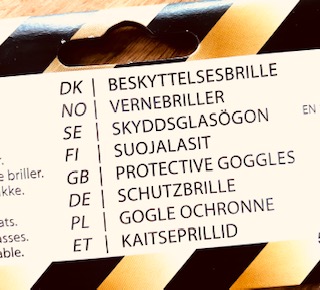
Each year words of the year are selected in different languages. Oxford Dictionary word of the year 2020 not surprisingly is ‘lockdown,’ Dutch word of the year is ‘anderhalvemetersamenleving’ – ‘one and a half meter community,’ the cute Flemish one ‘knuffelcontact’ – ‘hug contact/hug buddy,’ the obvious French ‘confinement,’ Norwegian koronaen – no translation needed, Russian ‘обнуление‘ – ‘zeroing‘ and ‘карантин’ – ‘quarantine,’ Chinese “大流行” (dà liúxíng) meaning ‘pandemic‘, and my personal favorite Danish ‘samfundssind‘ – ‘community spirit.’ Americans will announce theirs in January 2021, and the word of my year 2020 has to be a mask and it in at least three languages. First discussing and being aware of the need to wear one, then actually asking around and looking for to purchase one, then more than one, then a constant reminder to not leave home without one and put one on where and when required.
The year that has indeed been unique in many ways is going to its end. Knuffelcontact and samfundssind have been helpful to make it so far. Let’s cheer fresh, hopeful, and new beginnings of 2021.
*An article is used with nouns. In English, both ‘the’ and ‘a’ are articles, ‘the’ being definite and ‘a’ indefinite.
Sources: Aljazeera, Ethnologue, Euronews, Wikipedia, “Historical Linguistics” L. Campbell, “The Languages of the World” K. Katzner
 Ventral Striatum