Extraordinarily slow but not at all dull. Here in Denmark, the summer warmth filled air has made it quite enjoyable and relaxing with a whole slew of strolls and bike rides, nonstop reads of summer literature, and occasional sips of refreshing cocktails. There has been time for everything, it seems.
Certainly, it created an ideal condition to brush up old knowledge of at least two languages and pick up a new one. The online live-streamed language seminars, the course on language use, and teaching techniques, as well as one on applied linguistics* – all have been bliss and the highlights of the unforgettable summer 2020.
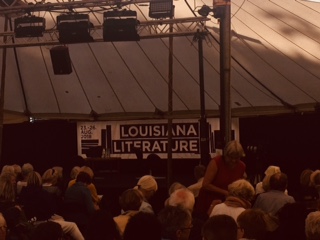
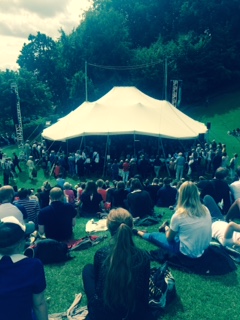
Summer is the time for festivals, normally. The summer arrived, but normality stayed absent. The ever awaited and the most missed event, which usually happens every August just nearby Copenhagen, is the Louisiana Literature Festival. The festival gathers the brightest stars of the literary constellation. There I was fortunate to be able to see and hear the most prominent authors such as Svetlana Alexievich (BY), Siri Hustvedt and her husband, Paul Auster (US), Édouard Louis (FR), Daniel Kehlmann (DE), and my personal hero Elif Shafak (TR), to name a few. How lucky I was there to discover less known though no less brilliant new names in literature such as, for example, Swedish poet Cia Rinne and her playful and melodious use of language. The annual festival spans several venues over four days in August since 2010. It even offers some tunes played by local bands for those who need music for a festival to be complete. Indeed, it gets complete and exceeds the highest expectations each time. Though this year, the festival was canceled for obvious reasons, several literary events to please literature fans have taken place, fortunately.
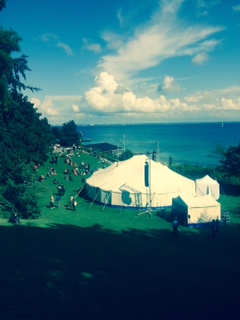
The literature festival organizers are the Louisiana Museum of Modern Art in Humlebæk, just about 35 km north of Denmark’s capital city – an attraction worth a visit round the year. The modern and contemporary art pieces are spread over the vast maze-like building on an inside and open space and a park outside. A cafe decorated with Danish design lounge furniture up on a hill overlooking the sea coastline is for a possible hygge lunch or light dinner. Yes, definitely worth a visit next time you are in the neighborhood. The museum remains open as usual these days, and I am sure it is busy planning a hefty literature festival comeback next year.
Summer is often the time for a holiday abroad. This year was no exception to start with. Then after having postponed our international get-together of friends from different corners of Europe in the warm and safe part of Portugal, already in a fall, the holiday could finally happen. Portugal is obviously home to the Portuguese language, which I have been learning on and off for about 10 years. It is a Western Romance language and closely related to Spanish, Catalan, and French. Some knowledge of Portuguese has inspired and helped me start learning Spanish. It is a good idea and always helpful to learn closely related languages, e.g., if learning Danish, you practically can claim you know Norwegian, if learning Russian, it opens the door to Ukrainian and even leads to Polish, Czech, and Serbo-Croatian grasps. Though related to Spanish, Portuguese has its unique features like the sounds dominated by fricatives * and thus does not necessarily sound Spanish. And remember when you want to say thank you in Portugal, it is not gracias but obrigado (masc.) or obrigada (fem.) depending on the gender you associate yourself with. Written Portuguese contains, however, more similarities with Spanish: many words are identical (amigo-friend, beber-to drink, primavera-springtime), and it is easy to follow some recurring patterns such as Portuguese words ending in -ça, -ção, -lho will respectively end in -za, -ción, -jo in Spanish (cabeça-cabeza, atenção-atención, trabalho-trabajo). When in Portugal, besides listening to people talk, making an effort to converse, I read everything my eyes come across – advertising, driving directions, tourist information, health experts guidelines. The text is often placed next to an English and, most often, Spanish translation. I feel like I am learning two languages at once, comparing them.
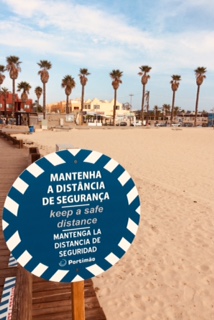
Portugal is one of these destinations one never gets tired of going back to. One of the first times in this charming land was memorable and definitely a reminder that some language knowledge comes in handy. Imagine renting a car in a foreign country, driving around in fascination, ignoring time and getting remote from the place you are staying, when finally having to fill your very ordinary, not exactly environment-friendly car before the sunset and heading back to the hotel, you are suddenly confronted with a choice between gasóleo (diesel) and gasolina (gasoline/petrol) and manage to fail to choose right and yes, are now stuck in a broken car for another three to four hours into the night before getting rescued by the rental company. What a painful, pricy, and unforgettable experience and a lesson learned: however foreign, distracted or exhausted, ask or check using GoogleTranslate, at the least.
Back home in lovely Copenhagen, me being me and having lots of time on my hands and easy access to the Internet, this summer, I chose to start an online class in a completely new and different language, namely Japanese. The closest related language I am familiar with is Mandarine Chinese due to its characters used in Japanese writing though the two have no genealogical relationship. So far, I have learned the script types, some grammatical curiosities and, a couple of phrases. More about it in a later post, so stay tuned.

To learn related languages is the trick to understanding more languages.
*Applied linguistics – the theoretical and empirical investigation of real-world problems in which language is a central issue (Ch. Brumfit 1977:93)
*Fricatives – sounds when air is forced through a narrow opening and sets up friction which causes noise, e.g. English fricatives are s, z, sh, th.
Sources: “Linguistics. An Introduction”, Andrew Radford et al., “The Languages of the World”, Kenneth Katzner.
 Ventral Striatum