Linguistically, this summer has been rich and full of discoveries.
The literal experience highly impacted this year’s holiday plans. Having read two out of four Elena Ferrante’s Neapolitan novels, the summer started in a multi-layered city of Naples which never quiets down, the opposite from now sleepy Mount Vesuvius watching undisturbed over its noisy neighbor. My very minimum Italian could never catch up with the local dialects until almost two weeks later it was possible to grasp some intelligible words used by the parents of our lovely host of a tiny cozy apartment in Anacapri. The delicious local foods, drinks, and openness of kind, friendly people played a big part, of course.
Amalfi coast and its two gems – the divine Ravello at the top and the Paper museum at the foot of the Amalfi (Lattari) mountains, were breathtaking. The latter, Museo della Carta, has been an enjoyable journey back to the 13th-century paper mill, which claims to be the oldest in Europe, to see how the original paper presses make paper. First, the mill was used to produce original cotton-based paper and later, for wood-pulp manufacturing.
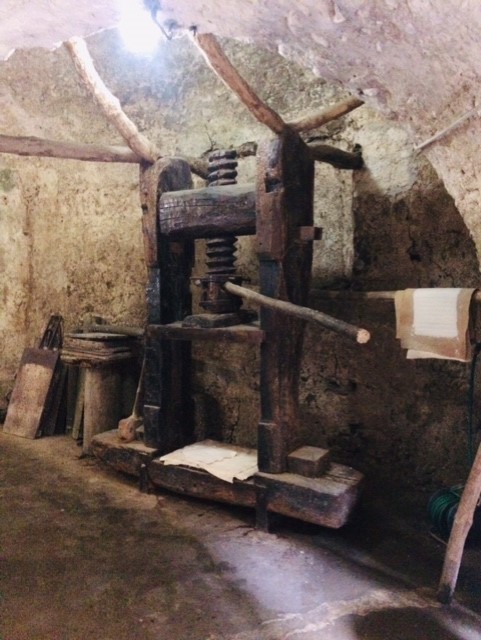
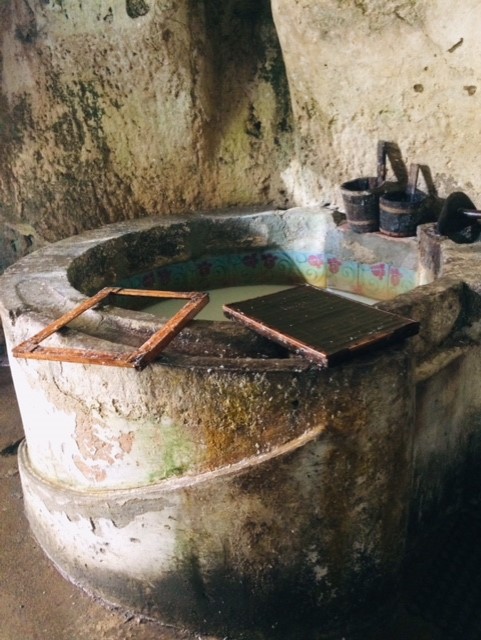
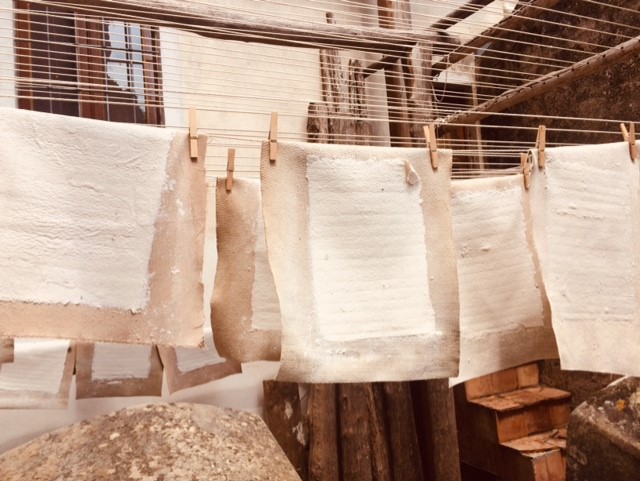
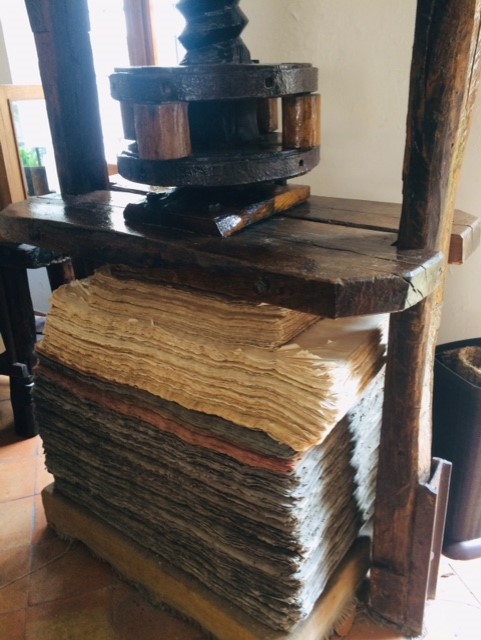
Paper was originally invented in China and possibly as early as some hundred years BCE and called after papyrus, Ancient Greek for the Cyperus papyrus plant, which was used in Egypt long before the Chinese invention. The papermaking process old fashioned way, which we could witness up close, seems to be quite complex, so please forgive me for an incohesive description of it presented here. The materials needed: rags of linen/hemp cotton/jute (nothing of animal origin or silk). The process of the preparation alone: (1) cleaning the rags cut by hand, (2) leaching – make the rags free from fats, (3) washing – in order to make rags free from lye, (4) fraying – a process to destroy all traces of fabric without the filaments being cut, (5) refining the filaments which then reduced into fibers suitable for making paper. Then, the mixture mass obtained from fraying and refining is diluted with water and now ready to be processed. The dough is placed on wooden drawers and immersed in the vat. The water is poured and leaves a thin layer of the material. The sheet of paper is then placed on a wool felt called pontoon and covered with another felt. The sheets are then stacked together to press out the remnant of water and dried hanging in special spreaders. Done, many many hours later.
Apart from traveling, films are a rich and fascinating source for language research. Two films watched during the summer, The Silent Child and Miracle, have been edifying and insightful in different ways.
British sign-language short film The Silent Child is a touching story about the relationship between a deaf four-year-old Libby and a social worker, Joanne, who does her best to enter Libby’s silent world and make her communicate with the one outside. The film was awarded an Oscar in the Live Action Short Film category this year. Two main takeaways from the film – one the inspiration by a highly professional and dedicated social worker who embodies an exemplary teacher-tutor-trainer and proves that everyone has the potential to learn, improve and achieve goals if given the right tools, encouragement, attention, time, and support. The other is realizing how little my knowledge about sign language(s) is in general. Did you know, for example, that there is a difference between British Sign Language and American Sign Language while both being English? There is certainly the same diversity in sign languages as in spoken ones. And as spoken languages, sign languages even have dialects and accents. If, for instance, I, a speaker of Lithuanian Sign Language, would want to learn Arabic Sign Language, I might use my fingers in the way most common for Lithuanian Sign Language users and an Arabic deaf person would notice my foreign accent. The signs are created to express meanings directly; for example, if I wished to say “I saw the movie” it would be expressed in signs in a similar matter as I/see/past tense/movie. If one wants to spell the name of a person or a place, one must do it letter-by-letter. There are two ways of spelling: the one-handed system (American) and the two-handed system (British used in the UK, Ireland, Australia, New Zealand). The important thing to know is that sign languages are equally complex and diverse as spoken ones and can express meanings of very simple things and the most sophisticated and abstruse notions.
Another, Lithuanian film Stebuklas (Miracle), was presented to the Copenhagen audience by its director, Eglė Vertelytė, and revealed some behind the scenes moments. One of the lead characters in the film, played by Vyto Ruginis, is an American who speaks Lithuanian. His real story appears to be quite peculiar. Vyto Ruginis was born to Lithuanian parents who then lived abroad and eventually moved to the US, where the boy stopped speaking his parents’ language at the age of 14. He never spoke Lithuanian again for nearly 50 years until the filming of the movie started in 2016. According to the director, by the time the film had been finished filming, Vyto spoke the language fluently. The only thing he had to aim for in the movie was his evident and somewhat exaggerated American accent.

Languages learned as children- much easier to pick up later in life. Some researchers claim, for instance, that adopted children to a different country have a real possibility to easier learn their very first language if picked up later as adults.
Sources: Wikipedia, David Crystal “A Little Book of Language” (2010).
 Ventral Striatum
One thought on “Summer of 2018”